Mauritania · Atlantic Coast · Coastal Experience
Mheijratt —
Ocean Meets Desert
Stand where golden Saharan dunes plunge straight into Atlantic surf — a collision of two worlds at the edge of the African continent.
Scroll
The more people, the lower the price per person.
This trip has a minimum group size requirement.
Find a departure that needs more people — pay the group rate
Share this trip and come back once you have enough people
We match solo & small groups regularly — we'll find a solution
Travel with others — pay the best group rate
Share the trip — travel together for less
We'll confirm within 24 hours via WhatsApp or email.
Share this trip with someone who might want to join you.
Mauritania · Atlantic Coast · Coastal Experience
Stand where golden Saharan dunes plunge straight into Atlantic surf — a collision of two worlds at the edge of the African continent.
Where Two Worlds Collide
No signal. No noise. Just Atlantic waves crashing against Saharan dunes, fish caught fresh and grilled on the beach, and a sky full of stars. 130km from Nouakchott — Mauritania's best kept secret.
Mauritania's Atlantic coastline is one of the least-visited stretches of shore on Earth. The Mheijratt area captures its essence: raw, untouched, and profoundly empty. The dunes here shift with the seasons, reshaping the coast in a slow-motion dance between Saharan winds and Atlantic currents. At dawn, the light turns the sand gold and the water deep indigo — a contrast that feels almost unreal.
For centuries, Imraguen fishing communities have worked these waters, pulling in mullet and other catch using traditional techniques passed down through generations. The coast was never settled by outsiders — it remains as it has been for millennia, one of Africa's last truly wild frontiers.
Mauritania's Atlantic shore is one of the few remaining places where the Sahara desert meets the ocean with absolutely no human development in between. No boardwalks, no resorts, no settlements — just raw nature on an almost geological scale. Camping here means falling asleep to the sound of surf crashing against dunes, with nothing but stars and sand in every direction.
The Experience
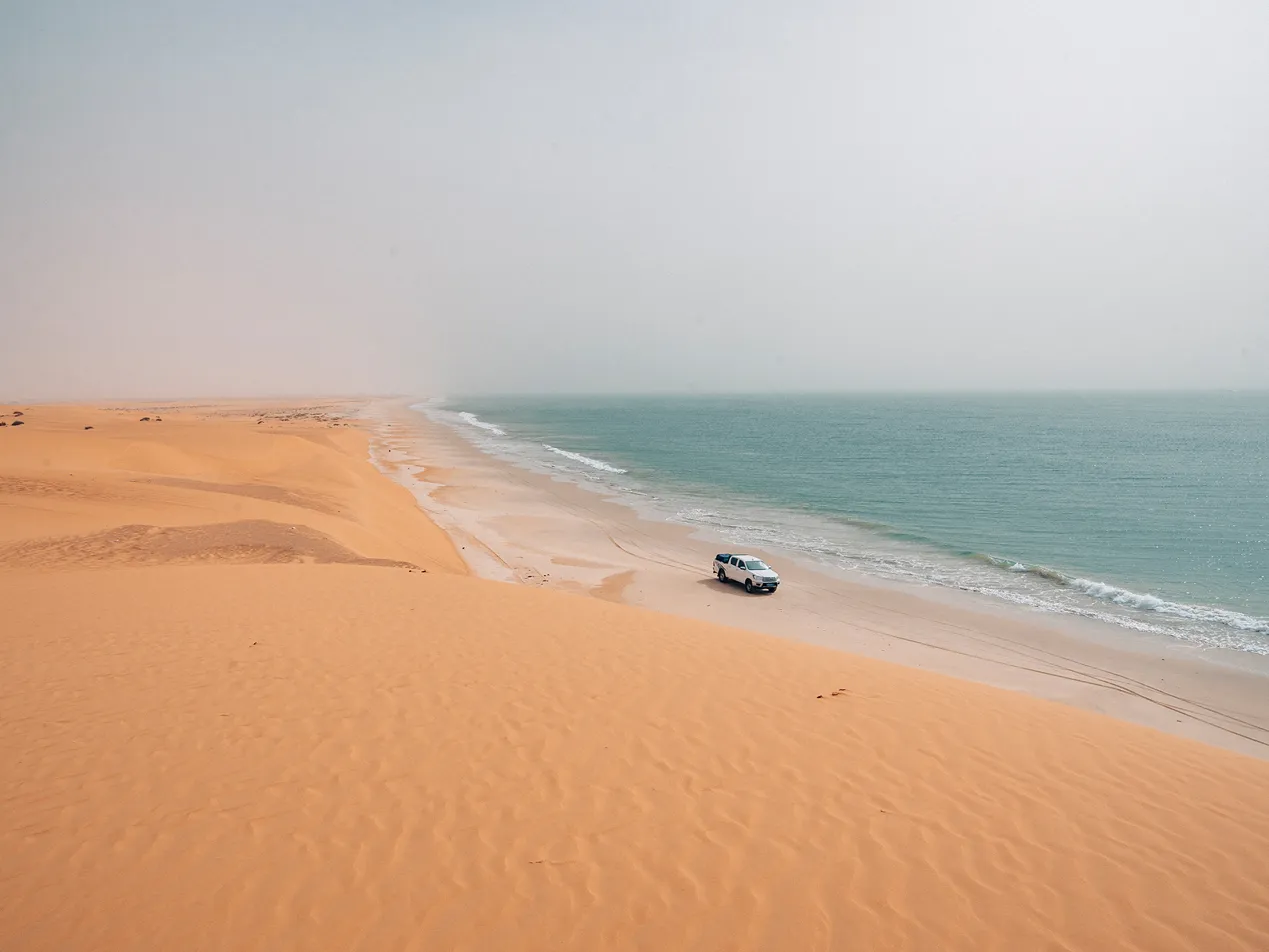
Watch golden Saharan dunes cascade directly into crashing Atlantic waves. The visual contrast is staggering — warm amber sand against deep blue-green ocean, with white foam tracing the boundary between two vast ecosystems. There is nowhere else on Earth where this collision happens so dramatically.
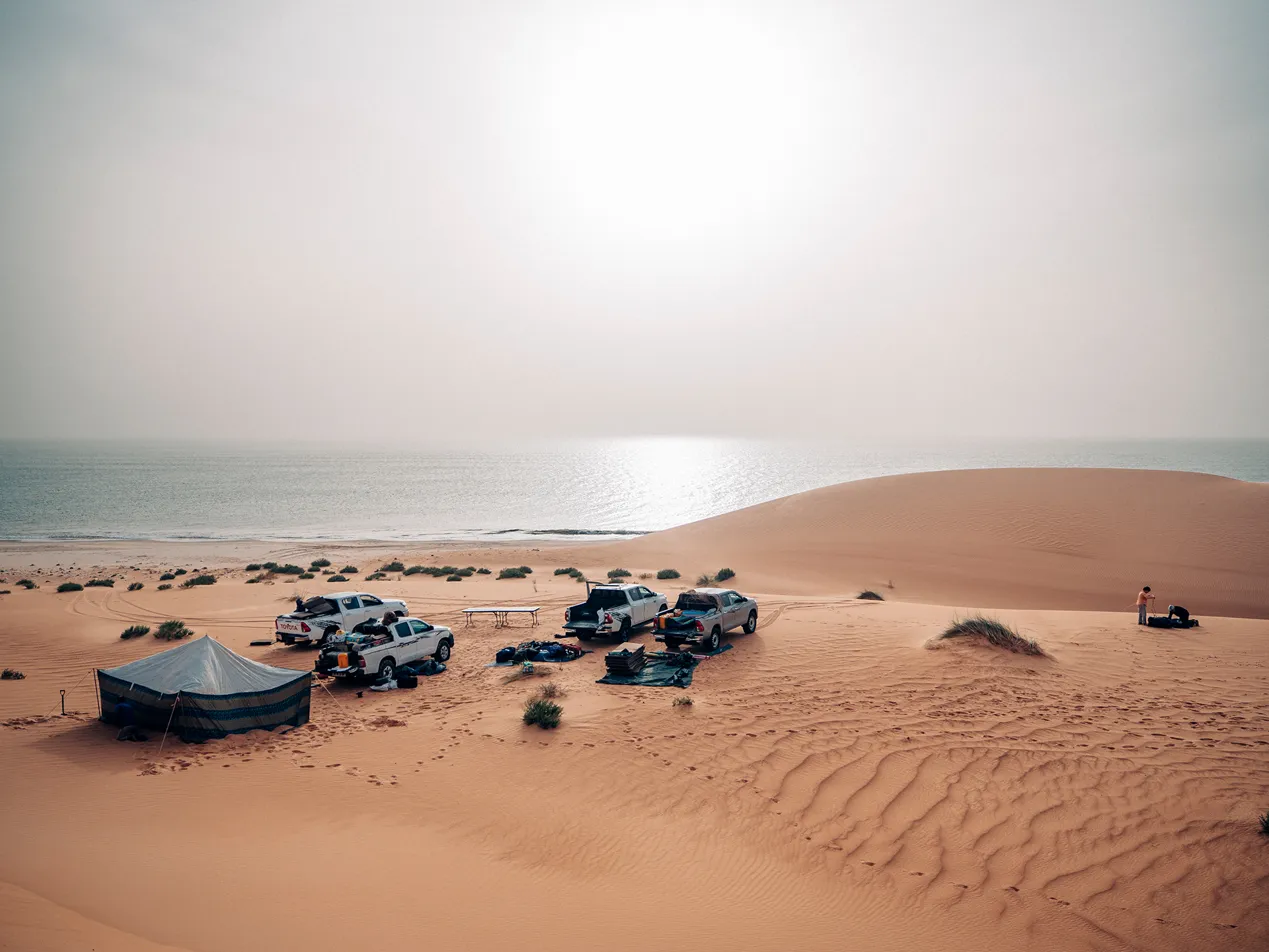
Iconic landscapeCamp directly on the dunes above the waterline. As night falls, the temperature drops, the stars appear, and the surf becomes your soundtrack. Your Yolo guide prepares Mauritanian tea and a fire-cooked dinner while the Milky Way stretches overhead. This is wild camping at its most elemental.
OvernightThe cold Canary Current that runs along Mauritania's coast creates one of the richest fishing grounds in the world. Dolphins are frequently spotted from shore, and the waters teem with fish. During the right season, you may spot sea turtles and, in rare cases, monk seals from the nearby Banc d'Arguin reserve.
WildlifeWith nothing on the horizon in any direction, the sunrises and sunsets here are extraordinary. The sun rises over the Sahara behind you, painting the dunes in deep orange, then sets into the Atlantic in front of you. The golden hour lasts longer than anywhere you've experienced — the light is simply different here.
Golden hourThere is no phone signal, no electricity, no running water, and no other travellers. Mheijratt is accessible only by 4x4, and your guide navigates by instinct and GPS across trackless sand. The isolation is complete — and liberating. For a few days, the modern world simply doesn't exist.
Off-gridThe Imraguen people have fished these waters for centuries using traditional nets and pirogues. If timing allows, your guide may arrange a visit to a nearby fishing camp, where you can see their catch landed and prepared. The Imraguen's relationship with the sea is one of Mauritania's most enduring cultural traditions.
Culture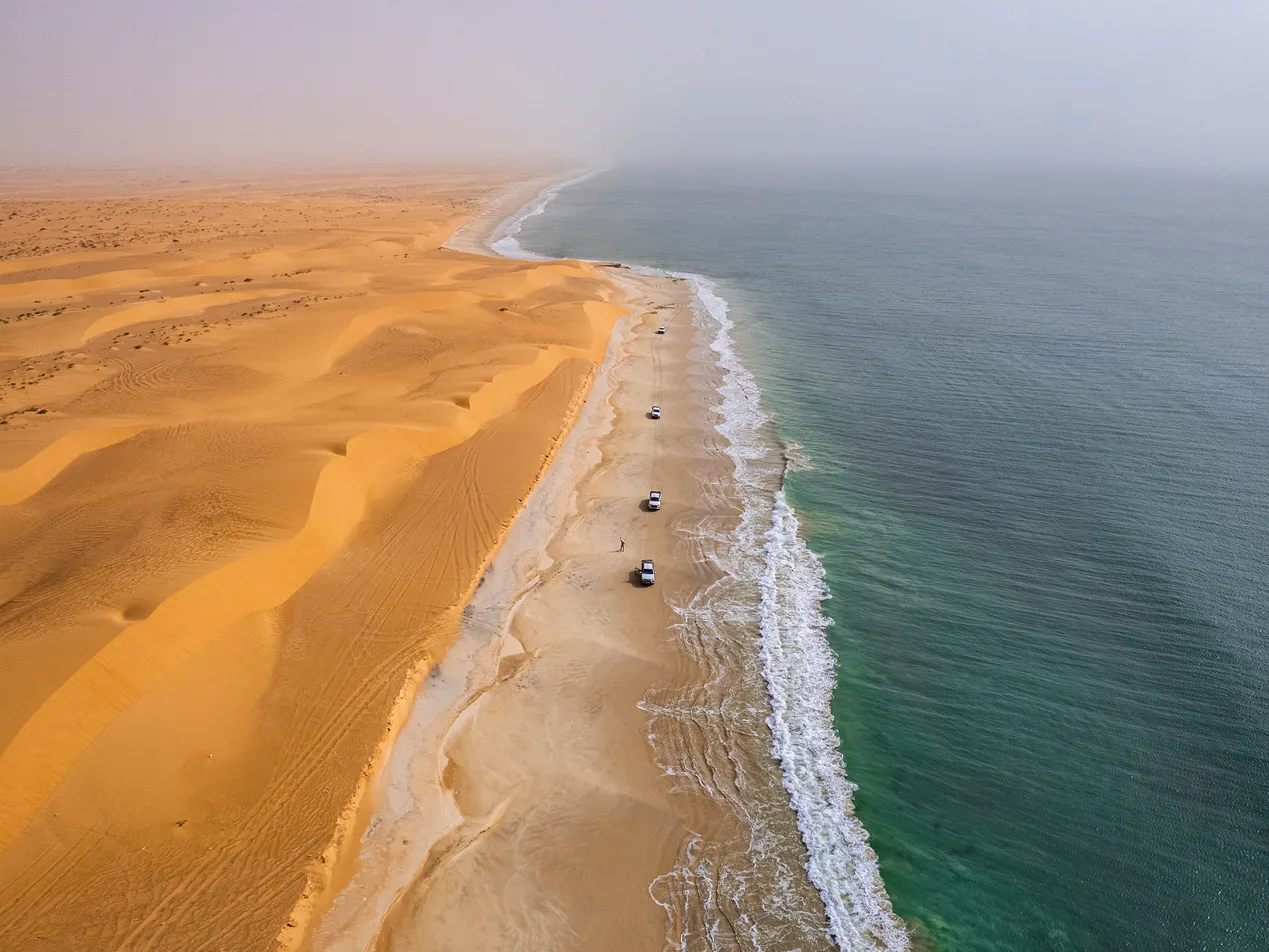
The Wild Coast
Mauritania's coastline is technically the longest unbroken stretch of unlit shoreline in the world. From Nouakchott northward to Nouadhibou, more than 500km of coast has no permanent settlements, no paved roads, and no infrastructure of any kind. The dunes simply roll to the sea and the sea rolls back.
Getting to Mheijratt requires a skilled driver and a properly equipped 4x4. There are no tracks to follow — the sand reshapes itself daily. Your Yolo guide reads the terrain, the tide, and the wind to navigate. It is this remoteness that makes the experience possible: you are seeing something that very few humans ever have, and that no development will ever change.
“I've seen the Sahara and I've seen the Atlantic. But nothing prepared me for the moment I saw one dissolve into the other. It's the most beautiful place I've ever stood.”— Traveller, Mheijratt Coast 2024
Before You Go
Mheijratt is reached by 4x4 along the coast, 130km from Nouakchott (3–5 hours depending on conditions). There are no roads — your driver navigates across sand and tidal flats. The journey itself is part of the experience. Yolo handles all transport and logistics.
Sunscreen (high SPF), sunglasses, a hat, light layers for the day and warm layers for the night, swimwear, sandals and closed shoes, a headlamp, and a camera with spare batteries (no charging). Yolo provides tents, sleeping gear, food, and water.
The standard Mheijratt experience is 3 days and 2 nights, with two nights of wild beach camping. Longer stays can be arranged. The pace is deliberately slow — this is a place for being, not doing.
The cooler months are ideal. Winter days are warm and sunny (25–30°C), nights are cool and pleasant. Summer heat makes coastal camping uncomfortable. The water is always cold due to the Canary Current.
No strenuous hiking required. The main challenge is the remoteness and lack of facilities — this is true wild camping. Suitable for adventurous travellers of all fitness levels who are comfortable with basic outdoor conditions.
All transport from Nouakchott, experienced guide and driver, camping equipment, all meals and water, Mauritanian tea ceremonies, and optional extensions to Banc d'Arguin National Park or Nouadhibou.
Day by Day
We leave the hotel at 8am. The road south takes us 120km along the coast before we turn into the sand — 10km of soft track where the city, the signal, and the noise all disappear together. We arrive at Mheijratt by 9:30am with the whole Atlantic in front of us and nothing else. The day is unstructured by design. Fish off the beach, walk the line where the dunes drop into the surf, or simply sit and watch the water. Whatever is caught gets grilled on the spot. We leave at 4pm and are back in Nouakchott by 6.
We leave at 8am. 120km of coast road, then 10km of sand, and the world changes completely. By 9:30am we are setting up camp on a beach with no other footprints. The day stretches out — fishing, walking, doing very little. We cook the catch over a fire as the sun goes into the ocean. There is no better sky in Mauritania than the one above Mheijratt at night.
Tea on the beach, a last walk along the waterline. We pack up around 9am and drive the 130km home, back in Nouakchott by 11.
Ready to Go?
Day trip from $249 · Overnight from $299 per person (group of 4). Coastal adventure including 4x4 transport, wild beach camping, all meals, guide service, and camping equipment.