Mauritania · Adrar Region · UNESCO World Heritage
Chinguetti
The seventh holiest city in Islam — a minaret unchanged for eight centuries, rising above dunes that are slowly, imperiously, reclaiming it.
Scroll
Book Your Visit
We usually reply within a few hours. Your details are never shared.
Mauritania · Adrar Region · UNESCO World Heritage
The seventh holiest city in Islam — a minaret unchanged for eight centuries, rising above dunes that are slowly, imperiously, reclaiming it.
The Seventh Holy City
Chinguetti was founded as a trading post by the Sanhājah Berbers in the late 8th century, growing along the great trans-Saharan routes to become one of the most consequential cities in West Africa. At its 13th-century peak, its population exceeded 20,000 — it housed 11 mosques, sheltered up to 30,000 camels, and traded in salt, dates, and gold flowing between the Sahara and the wider world.
But Chinguetti's true currency was knowledge. West Africa's most important centre of Islamic scholarship for centuries, it taught rhetoric, law, astronomy, mathematics, and medicine to students who had walked months across the desert to reach it. The city became so synonymous with learning and faith that, across West Africa, the entire region of Mauritania was simply called Bilad Shinqit — the land of Chinguetti.
Today the city holds UNESCO World Heritage status alongside Ouadane, Oualata, and Tichitt. Its ancient minaret — Mauritania's national symbol — still stands. The dunes encroach. And the manuscripts remain, held in family libraries that have guarded them for generations.
Chinguetti was inscribed on the UNESCO World Heritage List in 1996 as one of four Ancient Ksour of Mauritania. The designation recognises a city that served for centuries as the departure point for West African hajj pilgrimages, a centre of Islamic scholarship, and one of the most important nodes in the entire trans-Saharan trade network. UNESCO has also funded restoration campaigns to preserve its architecture against the advancing dunes.
What to See & Do
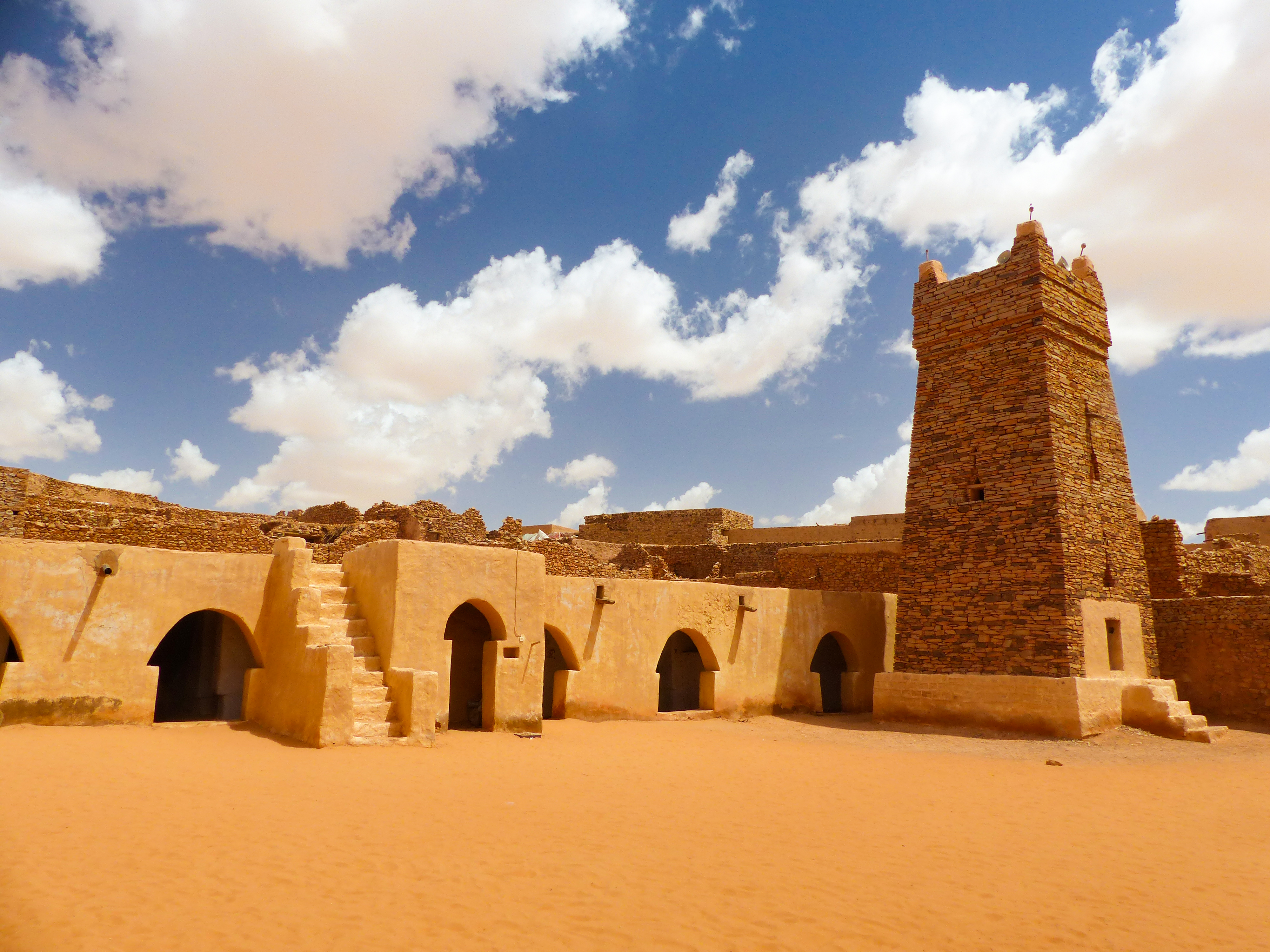
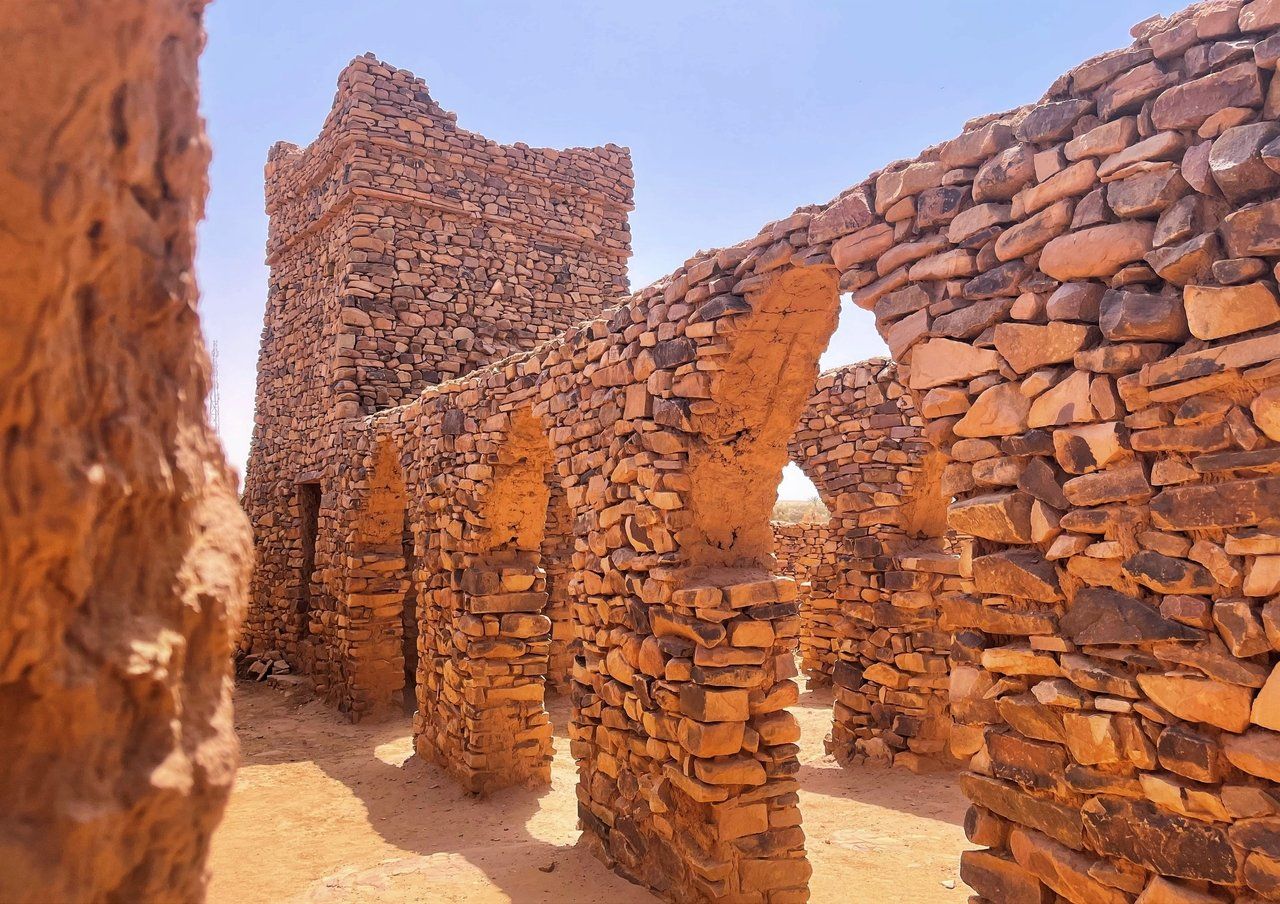
Chinguetti's ancient mosque carries the second-oldest continuously-used minaret in the Islamic world — its five ostrich eggs crowning the tower as they have for centuries, serving as Mauritania's national symbol. The surrounding old town is separated from the modern city by a seasonal ouad that floods in rainy season, creating a natural threshold between present and past.
National SymbolChinguetti's families have guarded extraordinary collections of Islamic manuscripts for generations — texts on theology, mathematics, astronomy, and law that predate most European libraries. Several family collections are open to visitors by arrangement. The Ahmad Mahmoud family museum also holds prehistoric artifacts, ancient board games, and ceremonial lances recovered from the surrounding region.
2–3 hoursThe "third Chinguetti" — the oldest settlement — now lies half-buried among the dunes that press in on all sides. Walking through these dunes at dawn or dusk, with the minaret visible above the ochre ridgelines, is one of the most quietly extraordinary experiences the Sahara offers. The encroachment is both threat and spectacle: a city fighting a slow, magnificent battle it cannot win.
Dawn or duskSouth of the old town, Chinguetti's banco mine has been extracting the adobe cement used to build and repair the city's mud-brick architecture for centuries. Accessed via a simple well system, this ancient quarry is a reminder that Chinguetti's buildings are not merely old — they are continuously, carefully maintained by a community that understands what it holds.
Living craftChinguetti sits at the centre of a web of ancient routes linking the desert oases of Entkemkemt, Lagueila, and Terjit. Camel treks of one to several days can be arranged to reach these water points — each one a green shock against the surrounding stone and sand. Two nights in Chinguetti is the recommended minimum; a week would not feel wasted.
Half day to multi-dayNear the old mosque, a women's cooperative sells handmade souvenirs — woven textiles, leather goods, and crafted items produced in the city. Buying here supports the families who have chosen to remain in one of the world's most remote inhabited heritage sites, maintaining the living fabric of a city that statistics suggest should long since have been abandoned.
Local craftA Desert Library
During Chinguetti's golden age, the city functioned as West Africa's most important centre of Islamic scholarship — teaching rhetoric, law, astronomy, mathematics, and medicine to students who had journeyed weeks across the Sahara to sit in its circles of learning. The knowledge accumulated here was recorded in manuscripts that have been held in family libraries ever since.
These are not museum pieces. They remain in the homes of the families who have guarded them across generations — collections largely undigitised, many unstudied by outside scholars, surviving in a desert climate that is simultaneously their greatest threat and their best preserver. Some collections run to thousands of volumes. Some are wrapped in cloth and stored in trunks that have not been opened in decades.
"In Chinguetti, the libraries are not institutions. They are inheritances — passed from father to son across centuries, in a city that has always understood the weight of what it carries."— Yolo Travel, Field Notes
Before You Go
Chinguetti lies 86km east of Atar, the regional capital of the Adrar. The journey by 4x4 takes around two hours on tracks that are navigable outside of the rainy season (June–October). Camel trekking from Atar is also possible. Atar is reached by daily flights from Nouakchott, with direct Paris connections in high season.
Two nights allows time for the old mosque and minaret, a manuscript library visit, a dune walk at dawn, the banco mine, and an evening in the ouad between the old and new towns. Three nights opens up a half-day camel trek to a nearby oasis — the version of this trip that most visitors wish they had booked.
The Adrar region is cooler and more accessible between October and April. The rainy season (June–October) can make tracks impassable and flood the ouad. Winter nights in the desert can be cold — bring layers. The light in November and March is exceptional for photography.
The old town is explored entirely on foot — its lanes are narrow, its dune passages require no vehicle. A Yolo-arranged local guide is essential for manuscript library access, which requires personal introduction to the families involved. The dunes and oases are best reached by camel or 4x4.
Chinguetti's seasonal ouad can flood during the rainy months, temporarily creating a lake between the old and new towns. While atmospheric, this period also limits road access. Yolo monitors conditions and advises on timing — in some years the rains arrive early; in others, barely at all.
Chinguetti is not a site you move through quickly. Its most rewarding moments are quiet ones — a conversation in a library courtyard, a minaret at first light, the sound of wind over dunes at dusk. Come with time and without urgency. The city rewards those who move at its pace.
Ready to Go?
From $420 per person. Includes expert local guide, old mosque and minaret visit, manuscript library access, dune walk, camel trek to a nearby oasis, and all transport and accommodation arrangements.