Mauritania · Adrar Region · UNESCO World Heritage
Ouadane
A 12th-century walled city built into the rock itself — neighbour to the Eye of Africa, gateway to the eastern Sahara, and keeper of the Street of the Forty Sages.
Scroll
Book Your Visit
We usually reply within a few hours. Your details are never shared.
Mauritania · Adrar Region · UNESCO World Heritage
A 12th-century walled city built into the rock itself — neighbour to the Eye of Africa, gateway to the eastern Sahara, and keeper of the Street of the Forty Sages.
Ancient Trading City
According to tradition, Ouadane was founded in the 12th century by three hajj pilgrims who recognised the strategic potential of this clifftop site above the eastern Adrar Plateau. They were right. The city grew quickly into a major node in the trans-Saharan trading network — a place where gold was exchanged for dates and salt, where caravans rested before the long desert crossing, and where scholarly reputations were made on what came to be called the Street of the Forty Sages.
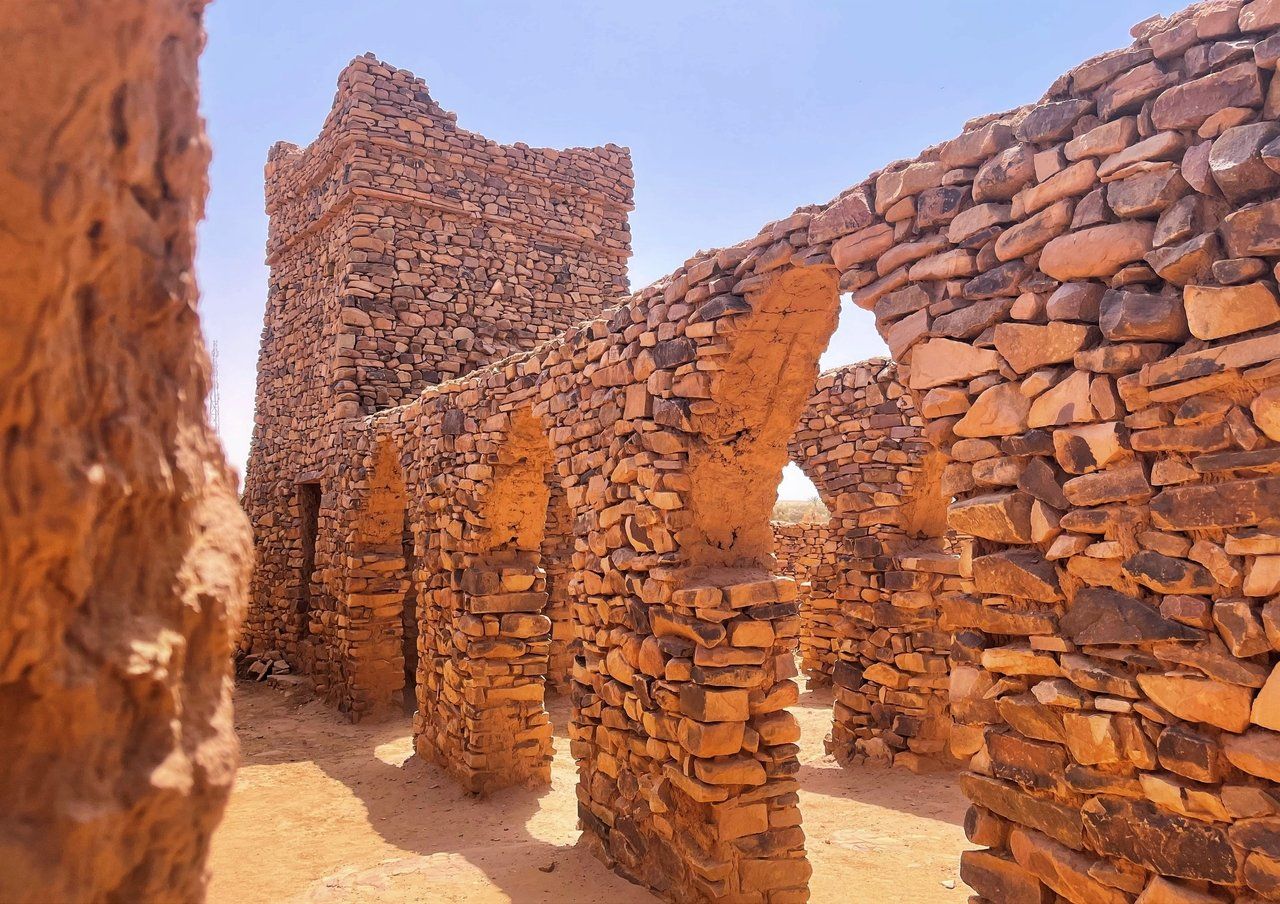
The ksar — the fortified old town — was literally constructed from the plateau rock, its adobe buildings pressed against stone outcrops and narrow staircase lanes connecting the different levels of the hill. It remains largely intact today, occupied by a small population who maintain the same date plantations that have fed the city for eight centuries.
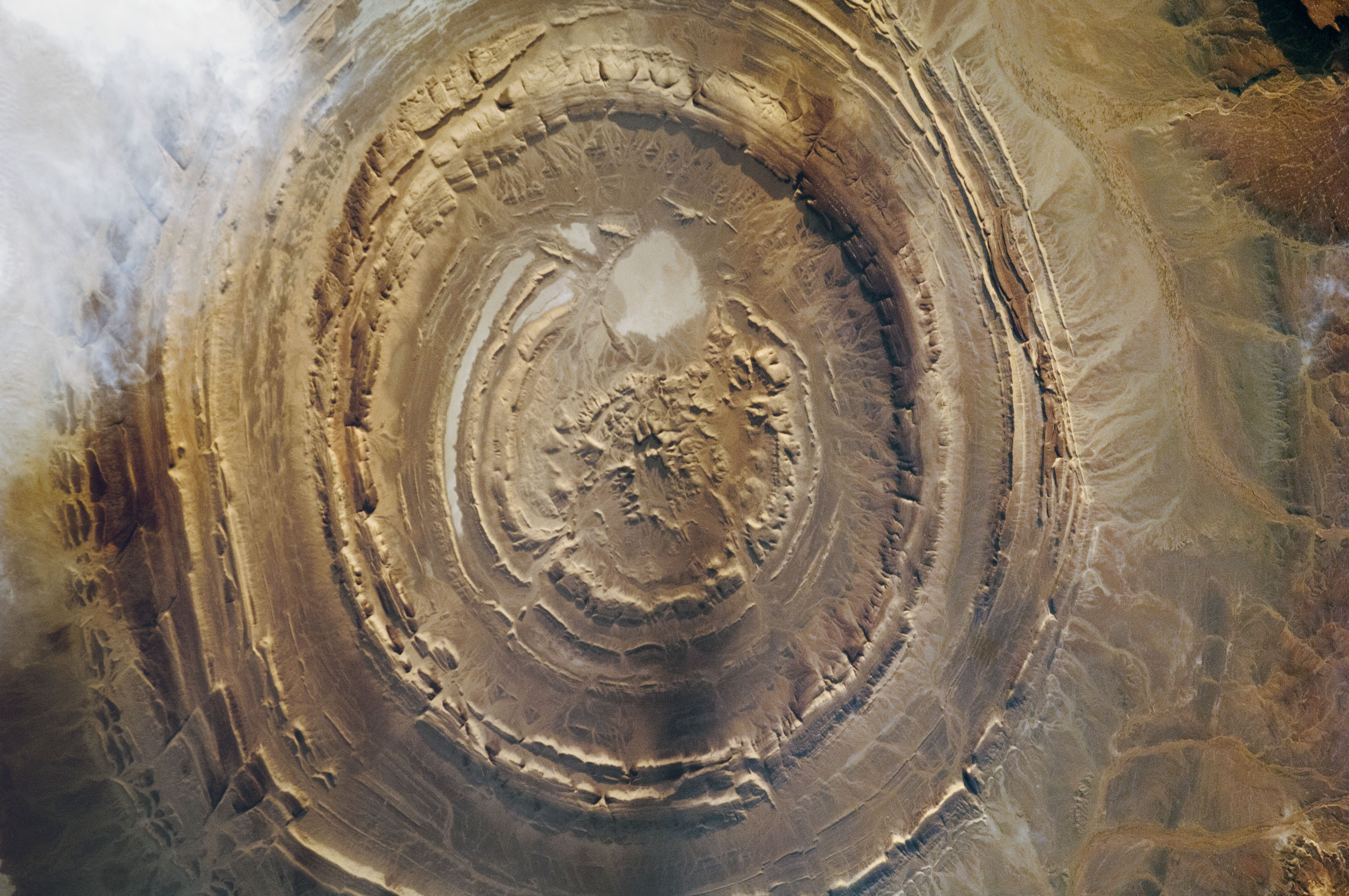
Ouadane holds UNESCO World Heritage status alongside Chinguetti, Oualata, and Tichitt. Its particular distinction is its proximity to the Richat Structure — the mysterious 50-kilometre geological formation visible from space, known to travellers as the Eye of Africa, sits just 25 kilometres to the west.
Ouadane was inscribed on the UNESCO World Heritage List in 1996 as one of the four Ancient Ksour of Mauritania. The designation recognises the city's exceptional preservation — its 15th-century mosque, its houses of the founding pilgrims, and its ksar built into the living rock — as outstanding examples of trans-Saharan urban heritage. The surrounding date oasis adds a living agricultural dimension that few comparable sites can claim.
What to See & Do
Ouadane's ancient mosque — partially restored but still carrying the weight of centuries — stands at the heart of the old town. Its minaret is a reference point for the entire ksar. The mosque serves an active community, and visitors are welcomed outside of prayer times. The interior is notable for its proportions: modest in scale, vast in atmosphere.
Historic heartIn Ouadane's golden age, the main street of the ksar was lined with the homes and teaching circles of forty distinguished scholars — a concentration of learning that gave the city its intellectual reputation across the Sahara. Walking this lane today, between its high adobe walls and carved doorways, you are retracing steps that medieval students made on their way to an education that no other institution in the region could match.
Walking tourThe homes of the three hajj pilgrims credited with founding the city survive in the ksar, their architecture reflecting the 12th-century building traditions of the Adrar region. Visiting these structures with a local guide brings the founding story into physical focus — the building scale, the room arrangements, the views from each threshold — in ways that no historical account alone can provide.
Founding historySurrounding the ksar on its lower slopes, Ouadane's date groves have sustained the city since its founding. The oasis is best visited in the late afternoon, when the light turns the palms gold and the air carries the cool that the stone town cannot hold. The city museum, located within the settlement, holds a collection of historical literature about the region and the city's trading past.
Late afternoonNearby Fort Agouedir is the ruin of a Portuguese trading post — evidence of the Atlantic empire's attempts to redirect the trans-Saharan gold routes towards the coast and away from the interior cities. The fort's presence in the Adrar is a historical anomaly that speaks to how strategically important Ouadane's trade was considered by 15th-century European powers who had never visited it.
4x4 excursionAmong Ouadane's more unexpected residents: a colony of rock hyraxes — small, rabbit-like mammals — that have made the old town's stone walls and crevices their home. Encountering these curious animals among the medieval architecture is a reminder that the ksar, even in its current partially-ruined state, is a living ecosystem as much as a heritage site. Best spotted in the early morning and late afternoon.
Wildlife surprise25km West of Ouadane
The Richat Structure — Guilb er Richat in Arabic — is a 50-kilometre geological formation of near-perfect concentric rings, visible from orbit, that has puzzled scientists and captivated explorers since it was first photographed from space in the 1960s. It sits 25 kilometres west of Ouadane across open desert, and a visit to the Eye is one of the most surreal experiences the Sahara offers.
Standing at ground level within the formation, the scale defies comprehension — each ring is kilometres wide, carved into the ancient rock over hundreds of millions of years. No single viewpoint takes it all in. The only way to grasp the full structure is from the air, or by navigating across it on foot or by 4x4, ridge by ridge, ring by ring, until the geometry becomes something you can feel rather than merely see.
"The Eye of Africa is not a view. It is a reckoning with scale — the kind that recalibrates what you consider large for the rest of your life."— Yolo Travel, Field Notes
Before You Go
Ouadane is approximately three hours from Atar by 4x4, via asphalt road through Chinguetti or by unpaved track through the Tanouchert oasis. Most visitors combine Ouadane with Chinguetti in a two-city Adrar circuit. Atar is served by daily flights from Nouakchott. Yolo handles all logistics and piste navigation.
An overnight stay is the recommended minimum — sufficient for the mosque, the Street of the Forty Sages, the founding houses, and the date oasis, with a late afternoon walk through the ksar. Adding a second day allows a 4x4 excursion to the Richat Structure and Fort Agouedir without rushing either.
The Adrar's cooler season runs from October through April. Ouadane's clifftop position means it catches more wind than the valley towns, which is a relief in summer but can make winter evenings sharply cold. The light in the dry season is extraordinary for photography of the ksar's stone-and-adobe architecture.
The ksar is explored entirely on foot — its staircase lanes and tight passages require it. The surrounding landscape, the Richat Structure, and Fort Agouedir are reached by 4x4. A Yolo-arranged local guide provides essential context for the old town's history, points out the hyrax colonies, and facilitates entry to the city museum and historic buildings.
Ouadane's characteristic culinary offering is wild melon seeds, typically served crushed in a savoury soup — a preparation that reflects the ingenuity of desert cooking, using ingredients that survive the Saharan climate where most others cannot. Ask your host or guide to arrange a meal that includes it; it is a flavour that no other place in Mauritania replicates.
Camel tours of the surrounding landscape can be arranged in Ouadane, offering a pace and perspective on the Adrar plateau that 4x4 travel cannot match. Half-day and full-day routes are available, passing through the date groves, along the plateau edge, and into the desert terrain between Ouadane and the Richat Structure.
Ready to Go?
From $460 per person. Includes expert local guide, ksar and mosque visit, Street of the Forty Sages, date oasis walk, Richat Structure excursion, and all transport and accommodation arrangements.