The more people, the lower the price per person.
This trip has a minimum group size requirement.
Find a departure that needs more people — pay the group rate
Share this trip and come back once you have enough people
We match solo & small groups regularly — we'll find a solution
Travel with others — pay the best group rate
Share the trip — travel together for less
We'll confirm within 24 hours via WhatsApp or email.
Share this trip with someone who might want to join you.

Mauritania · Nouakchott → Azoueiga Dunes → Terjit Oasis → Atar → Chinguetti → Ouadane → Ben Amera → 🚂 Iron Ore Train → Nouadhibou
Board the longest train on Earth — 2.5km of iron ore wagons, 700km of Saharan silence, and a sky full of stars over the world's most extreme rail journey.


The World's Longest Train
The Mauritania Iron Ore Train — the Train du Désert — is the longest regularly operating train in the world. At 2.5 kilometres and 17,000 tons, it hauls iron ore from the mines at Zouérat and M'Haoudat 700km across the Sahara to the port city of Nouadhibou. Three times daily, it makes this journey — carrying the raw material that accounts for half of Mauritania's export revenue.
For travellers, riding the train means climbing into one of 200 open-air wagons filled with crushed iron ore and settling in for a 12-hour overnight journey through some of the most remote desert on Earth. There is no schedule. There are no seats. The wind, the dust, and the vast Saharan sky are your only companions.
The train has run since 1963, when the mining company SNIM built the railway to connect the iron deposits of the interior with the Atlantic coast. It was never designed for passengers — but locals and adventurers have ridden it for decades. Today, it remains both a critical economic lifeline and one of the most extraordinary travel experiences on the planet.
4km from the train tracks, Ben Amera is Africa's largest monolith — camp beside it the night before boarding the train at dawn.
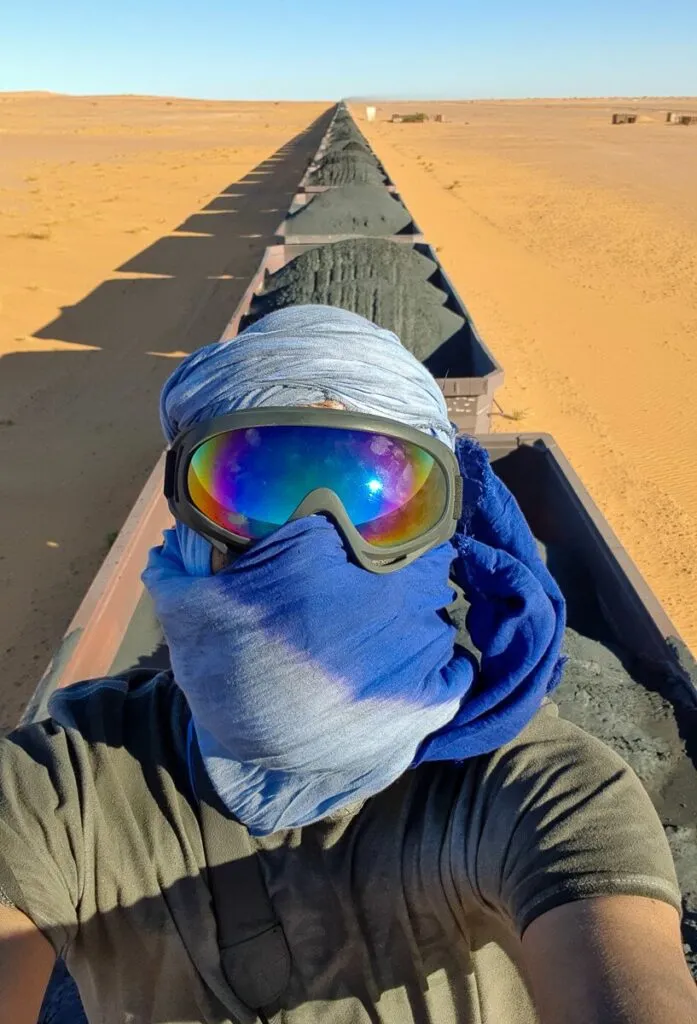
Riding atop crushed iron ore through the Sahara at night, with nothing but stars overhead and desert on all sides — the Iron Ore Train is not comfortable, not predictable, and not for everyone. But for those who ride it, it becomes the journey of a lifetime. The train departs when the train departs. You arrive covered in iron dust. And you never forget it.
The Journey
Riding atop the wagons at night, the Sahara reveals its greatest spectacle. With zero light pollution across hundreds of kilometres, the Milky Way stretches from horizon to horizon. The iron ore beneath you is still warm from the day's sun. The stars above are more than you have ever seen.
After sunsetThe journey begins in Choum, a small desert settlement where travellers wait — sometimes for hours — for the train to arrive. There is no platform, no timetable, no announcement. Your guide knows when to listen for the distant rumble. Patience is part of the adventure.
Starting pointWithin minutes of departure, a fine red-black dust begins to coat everything — your clothes, your face, your bag. By journey's end, you'll look like a miner. Ski goggles and a cheche (turban) are essential. Embrace the dust — it's the price of an incomparable experience.
Be preparedYou won't ride alone. Local Mauritanians share the wagons — traders, miners, families moving goods between the interior and the coast. The cultural exchange on the train is often the journey's highlight: shared tea, conversation in the dark, the warmth of strangers in a vast landscape.
Cultural exchangeAfter 12 hours, the train reaches the Atlantic coast at Nouadhibou. You step off covered in dust, exhausted, and transformed. A support vehicle meets you with water, fresh clothes, and the promise of a shower. The contrast between the desert journey and the coastal morning light is staggering.
Journey's endThe train passes within 3km of Ben Amera — Africa's largest monolith, rising 633m from the desert floor. In daylight, this massive granite formation is visible from the wagons. Many travellers combine the train ride with a visit to Ben Amera, camping at its base before boarding.
Nearby attraction
A Working Railway
The Iron Ore Train is not a heritage railway or a scenic tourist route. It is a working industrial lifeline — the artery through which Mauritania's most valuable export flows from mine to port. SNIM, the national mining company, moves 16.5 million tons of iron ore annually along these tracks. The single passenger carriage attached to the rear is an afterthought. The real way to ride is in the open wagons, atop the ore itself — as locals have done for sixty years.
Four American diesel locomotives, each generating 2,425 kilowatts, pull the 200-wagon train at roughly 50km/h. The journey is loud, jerky, and relentlessly dusty. But the pace is leisurely enough that you can watch the desert change — from rocky hammada to soft erg, from golden dunes to the flat coastal sebkha — as the train traces a line across one of the emptiest landscapes on Earth.
“It's loud and jerky, the dusty iron ore blows in your face. But then the sun sets, the stars appear, and you understand why people cross the world to ride this train.”— Traveller, Iron Ore Train 2024
Before You Go
The train boards at Choum (accessible by 4x4 from Atar, ~4 hours) or Zouérat. Most travellers board at Choum for the overnight ride to Nouadhibou. Your Yolo guide handles all logistics and timing — there is no fixed schedule.
High-quality ski goggles (not sunglasses), a cheche or turban for face protection, a heavy windbreaker or sleeping bag for the cold night, old clothes you don't mind getting stained with iron dust, and a headlamp. Yolo provides professional-grade goggles.
The Choum to Nouadhibou leg takes approximately 12 hours, departing late evening and arriving early morning. The full Zouérat to Nouadhibou route is about 20 hours. Speed averages 50km/h.
The cooler months offer the most comfortable riding conditions. Summer nights can still be freezing at 2 AM despite daytime heat. Winter rides offer the clearest skies and most dramatic temperature contrasts.
No physical fitness required, but be prepared for extreme temperature swings, constant dust, no bathroom facilities, and up to 12 hours in an open wagon. Not recommended for those with respiratory conditions.
Yolo's Iron Ore Train Expedition includes all transport to Choum, guide service, protective gear, a support vehicle meeting you at Nouadhibou, accommodation, meals, and optional extension to Ben Amera or Banc d'Arguin.
Day by Day
We depart at 8am. Akjoujt tea stop at 11am. Azoueiga dunes by 3pm — tall, gold, completely still. Sunset from the top, fire at the bottom, the Sahara in every direction.
The oasis arrives like a reward after 160km of piste. Palm trees, cold spring water, shade. We spend the afternoon here and sleep in a guesthouse. After today the accommodation gets more basic.
Atar at 9am, Chinguetti by 10:30am. A city that was once a gathering point for pilgrims heading to Mecca, scholars trading manuscripts, and merchants crossing the Sahara. The old town is half-buried in sand and still inhabited. We sleep here.
The last town before the real desert begins. We explore the UNESCO old quarter and eat with a local family. Tomorrow the road ends.
We leave the paved world behind and drive 230km northeast through terrain that has no name on most maps. Remote camp. No signal, no sound, stars from horizon to horizon.
225km further brings us to Ben Amera — Africa's largest monolith, 633 metres of raw granite rising from a flat desert floor, completely alone out here. We explore its base and walk toward its smaller neighbour Aisha in the afternoon. We camp at the rock as the light leaves it. This is one of the strangest and most memorable places on the entire itinerary.
The train tracks are 4km from camp. We spend the morning at the monolith and drive to Choum in the afternoon to board the Iron Ore Train. There are no passenger carriages — we ride in the open ore wagons, the train running 2km long behind a single engine. It crosses 700km of Sahara overnight. You sleep under open sky with the desert moving past you in the dark. It is unlike anything else.
The train pulls in at dawn. Guesthouse. Shower. A long breakfast. Nouadhibou is not a polished city — it is a working Atlantic port with one of the largest artisanal fishing operations in West Africa, and it is fascinating precisely because of that. Late afternoon at Cap Blanc if the timing works.
The trip ends here. A slow final morning in Nouadhibou before your onward flight — or the road south if you are staying in Mauritania longer.
Ready to Ride?
From $1,299 per person (group of 4). 9-day expedition including the Iron Ore Train ride, desert camping, guide service, all transport, accommodation, and support vehicle.