The more people, the lower the price per person.
This trip has a minimum group size requirement.
Find a departure that needs more people — pay the group rate
Share this trip and come back once you have enough people
We match solo & small groups regularly — we'll find a solution
Travel with others — pay the best group rate
Share the trip — travel together for less
We'll confirm within 24 hours via WhatsApp or email.
Share this trip with someone who might want to join you.

Mauritania · Nouakchott → Azoueiga → Terjit → Chinguetti → Ouadane → Richat → Ben Amera → 🚂 Iron Ore Train → Nouadhibou → Banc d'Arguin → Mheijratt → Nouakchott
Everything. In one loop. 13 days. Nothing retraced. The complete Mauritania.


The Complete Mauritania
Everything. In one loop. Africa’s tallest dunes, a desert oasis, two ancient UNESCO cities, the Eye of Africa, the world’s largest monolith, the Iron Ore Train, a UNESCO coastal park, and a hidden beach where the Sahara meets the Atlantic. 13 days. Nothing retraced. The complete Mauritania.
The route begins and ends in Nouakchott, looping north through the Adrar plateau, east into the deep Sahara, west to the Atlantic coast, and south along the ocean back to the capital. Every major destination in the country — connected in a single, continuous circuit. No backtracking. No repeated roads. One complete loop through the entire nation.
13 days across every landscape Mauritania has to offer — towering Saharan dunes, hidden desert oases, ancient medieval cities, the Eye of Africa seen from inside, the longest train on Earth, a UNESCO marine park, and wild Atlantic beaches. One continuous loop. Nothing retraced. The journey that covers the entire country.
The Journey
Mauritania’s tallest sand dunes — towering walls of golden sand in the deep Sahara. Climb to the summit at sunset and watch the desert turn amber beneath you. Camp at the base under a sky with more stars than you have ever seen.
Day 1Two UNESCO World Heritage cities — Chinguetti, the 7th holy city of Islam with its ancient manuscript libraries, and Ouadane, a stone medina perched on a rocky plateau. Medieval trading posts where sand drifts through streets unchanged for centuries.
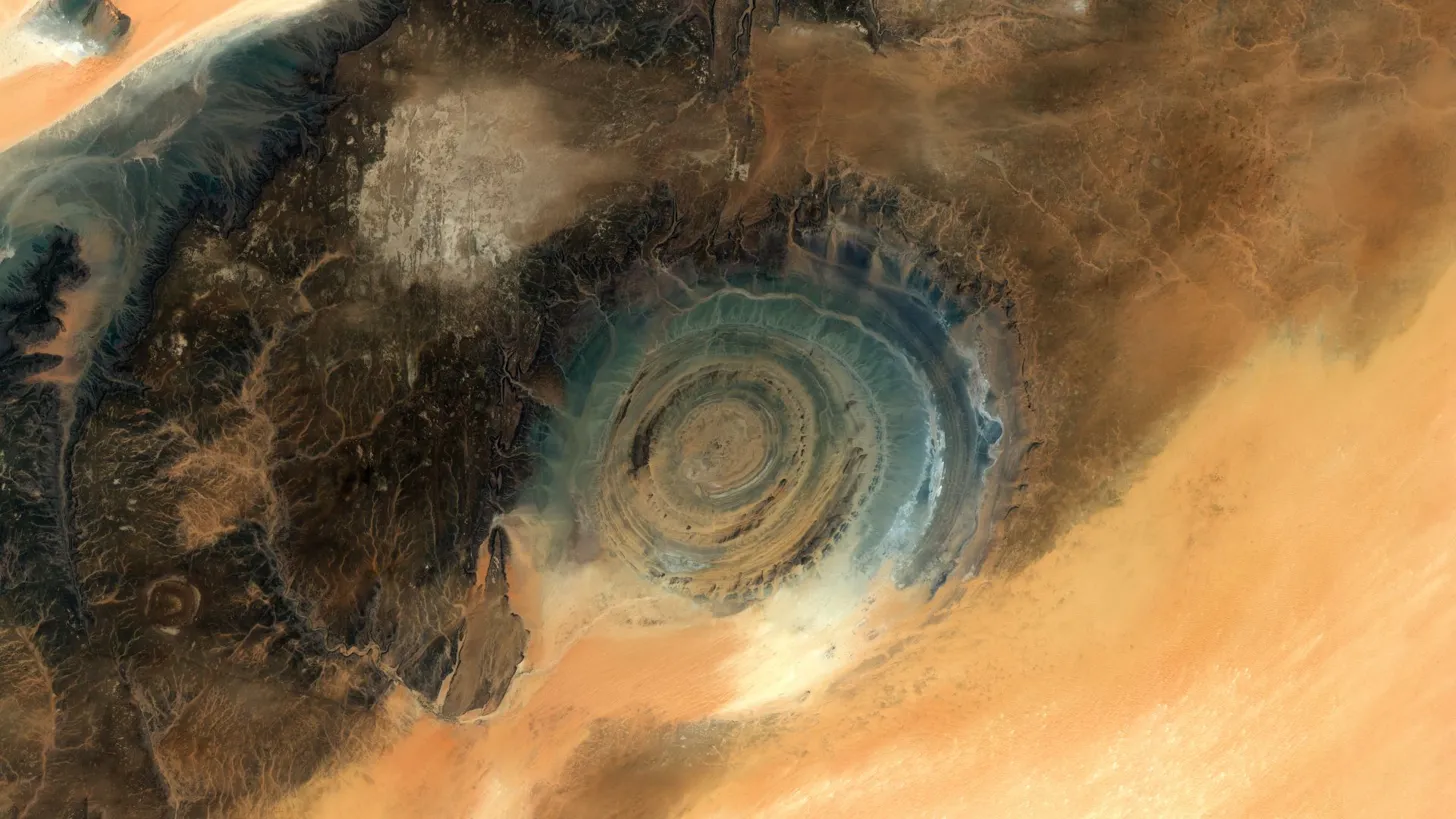
Days 3–4The Richat Structure — 50km wide, visible from space, and one of the most mysterious geological formations on Earth. Stand inside the Eye of Africa and camp at the most surreal campsite on the continent.
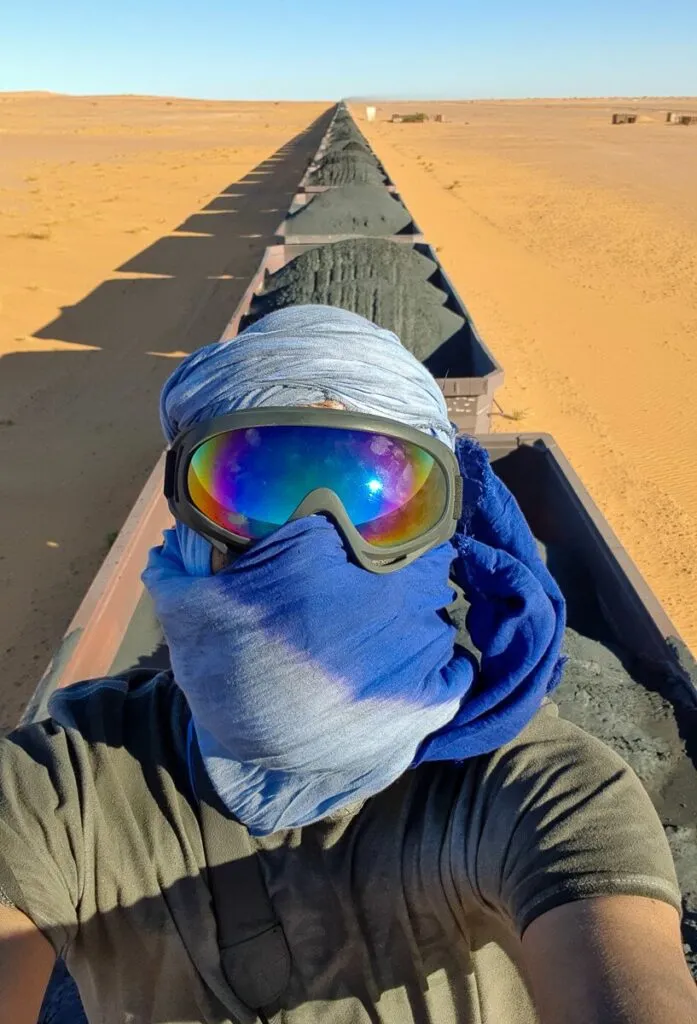
Day 5Board the longest train on Earth — 2.5km of iron ore wagons, 700km of Saharan silence overnight to the Atlantic. The most extreme rail journey on the planet, from deep desert to crashing ocean in one night.
Day 8A UNESCO World Heritage coastal park where the Sahara meets the Atlantic. Board a traditional Imraguen dhow, spot flamingos, pelicans, and dolphins. Camp on the sandbanks at dusk in one of West Africa’s most pristine marine ecosystems.
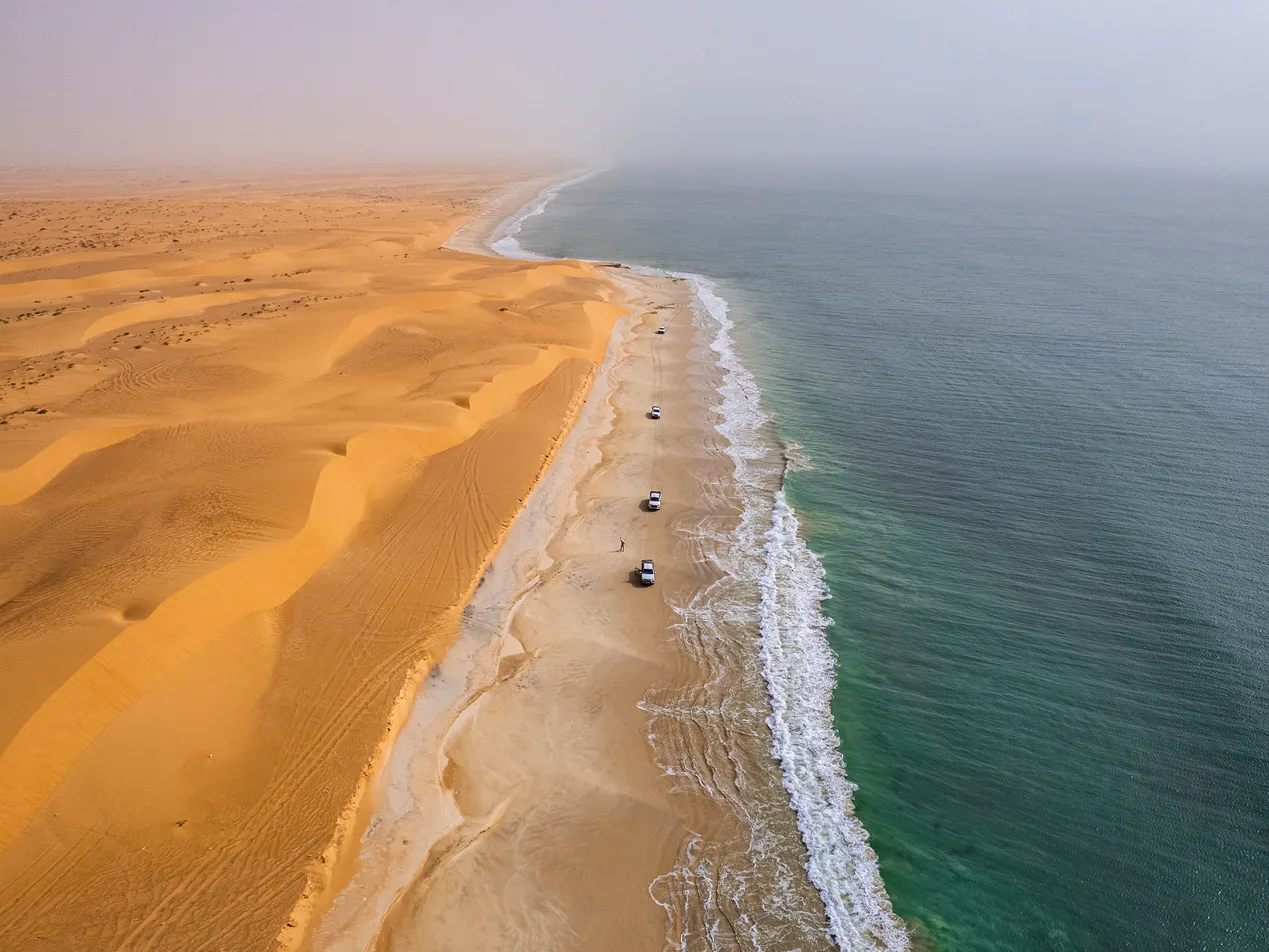
Day 10The hidden gem — a wild beach where Saharan dunes crash directly into Atlantic surf. Fish, light a fire, cook what you catch. Two nights at the perfect final stop before completing the loop back to Nouakchott.
Days 11–12
The Full Circuit
The Grand Mauritania is not a collection of highlights stitched together — it is a single, continuous journey through an entire nation. From the capital to the tallest dunes, through ancient cities and the Eye of Africa, aboard the longest train on Earth, along the Atlantic coast, and back again. Every kilometre connects to the next. Every landscape flows into another. The route never doubles back.
This is the trip for travellers who want everything — desert, ocean, history, adventure, solitude, and culture — in one unbroken arc. 13 days. 2,741km driven. 700km by train. The complete Mauritania.
“We started in Nouakchott and ended in Nouakchott. In between, we saw the entire country. Nothing repeated. Nothing missed. It was the perfect loop.”— Traveller, The Grand Mauritania 2025
Before You Go
A full 13-day loop starting and ending in Nouakchott. Desert camping, guest house stays, and wild beach camps. Every night is different.
Minimum 3 travellers per booking. Travelling solo or as a pair? Contact us — we will match you with an upcoming group departure.
All transport (4x4 + Iron Ore Train), guide service, all meals, camping equipment, guest house accommodation in Nouadhibou, protective gear for the train, and support vehicle.
The cooler months offer the most comfortable conditions for desert camping and the train ride. Winter nights can be cold — sleeping bags provided.
Long driving days on desert tracks, basic camping conditions, one overnight train ride, and limited connectivity for several days. Suitable for adventurous travellers in good health.
The loop begins and ends in Nouakchott. Fly into Nouakchott International Airport (NKC). We handle everything from there.
Day by Day
We depart from the hotel at 8am. The city fades quickly behind us as the road stretches north and the landscape hardens into full Sahara. Around 11am we pull off for tea in Akjoujt — the last real stop before the sand takes over. By mid-afternoon we reach the Azoueiga dunes, the tallest in Mauritania. We hike to the top before sunset, the whole desert spreading out below us in every direction. Dinner is cooked over a fire at the base of the dune. We sleep under the stars.
An 8am departure and 160km of desert driving brings us to Terjit by midday. The oasis opens up without warning — a narrow gorge of palm trees fed by a natural spring, hidden inside the Adrar plateau. We swim in cold clear water in the middle of the Sahara. We rest and watch nomads water their camels. We spend the night at a local guesthouse, preparing for the days ahead.
An early start brings us to Atar by 9am for breakfast and a walk through the market. We push on into the desert, the piste narrowing as we approach Chinguetti — a city founded in the 13th century that once drew pilgrims and scholars from across the Islamic world. We explore the manuscript libraries, walk the sand-filled streets of the old medina, and visit the Friday Mosque with its iconic ostrich egg finials. We stay in a local guesthouse as the desert wind picks up after dark.
We set off at 8am into the open plateau. The 128km to Ouadane takes around three hours, and the scenery is unlike anything from the day before — wider, more exposed, the horizon completely unbroken. Ouadane was once a crossroads of trans-Saharan trade and is today a UNESCO World Heritage Site. We walk the collapsed caravanserais and stone alleyways of the old quarter, share a traditional meal in a local home, and camp at the foot of the ancient walls as the temperature drops and the stars appear.
This morning we take a detour into the desert to see the Eye of Africa — a 50km-wide geological bullseye visible from space, sitting quietly in the sand as if the earth folded in on itself millions of years ago. We drive the 35–45km out and spend the morning walking the outer rim. Back in the vehicle by noon, we begin pushing northeast — the landscape becoming more remote with every hour. We camp deep in the desert, far from any road.
A long drive today, roughly 230km of open piste. This is the Mauritania that does not appear in guidebooks — no landmarks, no signs, no other vehicles. Just dunes, gravel plains, and silence. We navigate by GPS and instinct. By late afternoon we set up camp within reach of the Iron Ore Train tracks. The temperature drops sharply after sunset.
We visit Ben Amera in the morning — Africa's largest monolith, 633 metres of bare rock rising from the desert floor, 4km from the train tracks. It is enormous and completely alone out there. After exploring Ben Amera and its smaller neighbour Aisha, we make our way to Choum to board the Iron Ore Train. There are no passenger carriages — we ride in the ore wagons, the train stretching for over 2km behind us. The train moves at night, the desert sliding past in the dark. It is one of the strangest and most memorable nights of the trip.
The train pulls into Nouadhibou in the morning, dusty and unforgettable. We check into a guesthouse, shower, and spend the day at our own pace. Nouadhibou sits at the tip of a long peninsula, flanked by the Atlantic on two sides. The fishing port is one of the largest artisanal operations in West Africa. In the late afternoon, if conditions allow, we drive out to Cap Blanc where the peninsula ends and monk seals occasionally haul out on the rocks.
We head south along the coast to the Banc d'Arguin National Park — a UNESCO World Heritage Site that shelters over a million migratory birds from Europe, Siberia and Greenland. We go out on a traditional dhow, the only kind of boat permitted inside the park, gliding through channels between sandbars while flamingos and pelicans feed around us. We spend the night in a tented camp with the sound of the ocean nearby.
We leave the park and continue south along the coast road, the Atlantic never far to our right. A long day on the road, but the light on the water changes every hour. We stop to cook lunch on the beach and push on until we find a camp spot for the evening.
We arrive at Mheijratt. No signal. No noise. Just Atlantic waves breaking against Saharan dunes and a sky so big it takes a moment to adjust. We spend the rest of the day fishing, walking the beach, and grilling the catch over a fire. There is nowhere else to be.
A full day at the beach. Those who want to fish, fish. Those who want to sleep in the shade of the dunes, sleep. This is the reward at the end of eleven hard and beautiful days. We cook together in the evening and stay up late around the fire.
We pack up at 8am. Ten kilometres of sand, then 120km of paved road, and we are back in the city by midday. Thirteen days. One loop. Nothing retraced.
Ready?
From $1,549 per person (group of 4). 13-day complete loop including desert camping, two UNESCO cities, the Eye of Africa, Ben Amera, the Iron Ore Train, Banc d'Arguin, Mheijratt, guide service, all transport, accommodation, and meals.